
[ad_1]
$3.99
It’s sufficient to purchase a loaf of bread or two litres of milk, however removed from Ontario’s $14.25 minimal hourly wage.
And but Uber Eats couriers working within the province say they’re incomes as little as $3.99 per journey earlier than ideas, months after the meals supply service carried out a brand new pay coverage in the course of the COVID-19 pandemic.
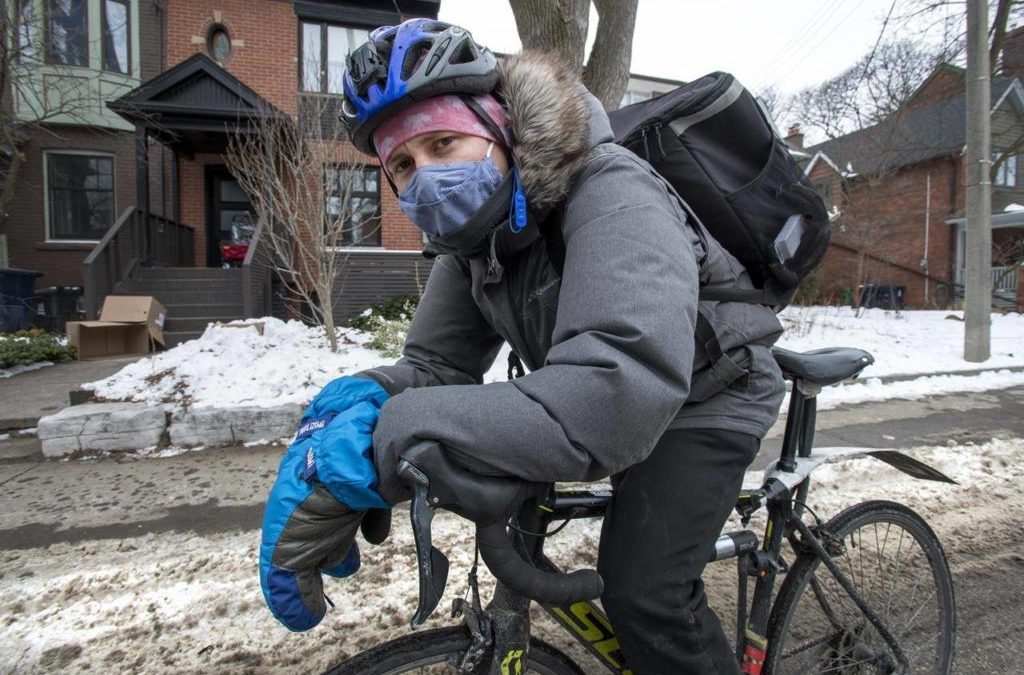
“I’m making so little now that I’m pondering what’s the level of even getting on the market if I’m simply going to make this a lot and it’s getting worse?” stated Spencer Thompson, a Toronto man who has been dropping off meals for Uber Eats since 2016.
He spent hours tabulating his 2020 pay and found what so a lot of his fellow couriers have lengthy suspected: their wages are shrinking at a time when persons are counting on meals supply greater than ever earlier than.
Thompson, for instance, made about $10 per journey — typically involving a number of stops — in January 2020, however by December, that had sank to as little as $3.99 per journey earlier than ideas.
The 60 per cent drop got here in a 12 months the place Thompson labored in Toronto’s downtown core almost on daily basis of the week through the lunch and dinnertime home windows, the place pay tends to be increased. He averaged two or three journeys an hour.
Couriers like Thompson, who aren’t formally employed by Uber however use its platform to select up work, fear the state of affairs may worsen and so they’ll be left with few different job alternate options as COVID-19 continues to unfold, unemployment stays excessive and firms more and more see the advantages of the gig financial system.
“We will’t let this go on and we are able to’t let this occur as a result of if we do, then the longer term might be all work like this,” stated Brice Sopher, an Uber Eats courier and organizer with the Gig Employees United union, who recollects making $9 or $10 per journey at first of 2020, however now averages half that.
Whereas couriers like Sopher and Thompson have lengthy warned of the gig financial system’s low pay, no job safety and lack of protection for accidents and sicknesses, their considerations grew to become much more alarming after final June.
That was when Uber scrapped its earnings construction providing couriers fastened quantities primarily based on decide ups, drop offs, distance and time and a collection of bonuses for utilizing the service throughout busy intervals or in high-demand neighbourhoods. By taking benefits of bonuses and extra rewarding orders, Thompson would land as a lot as $12.15 per journey earlier than ideas at first of 2020.
The brand new system Uber introduced in lowered base fares — totals couriers are provided to ship an order that fluctuate primarily based on time, distance, pickup and drop-offs — and began together with a visit complement to account for prolonged wait instances at eating places or distances couriers travelled to get there.
At first, the lowered base fares didn’t appear so dangerous as a result of the corporate would provide excessive “boosts,” which multiplied courier earnings in the event that they delivered meals in areas seeing a surge in demand, stated Sopher.
Below the brand new system, some staff have been even making a bit of greater than earlier than, however slowly the boosts decreased, he recalled.
“They did it little by little, so that you just wouldn’t discover,” he alleged. ‘However you’d have this sneaking suspicion.”
The modifications made ideas extra vital than ever earlier than, however clients are notoriously unreliable with regards to tipping couriers, stated Thompson. Some might be beneficiant, whereas others keep away from the additional handout altogether.
Uber, whose Eats service was first piloted in Toronto in 2015, stated in an e mail to The Canadian Press that it made modifications to its wage construction, together with lowering base fares, to higher replicate every journey’s whole time, effort and distance and embrace journey to the restaurant.
The modifications additionally concerned upfront pricing, which reveals couriers the assured web quantity they’ll earn for a supply earlier than they settle for the journey, alongside different particulars just like the restaurant identify and drop off areas. This permits drivers to say no journeys that they really feel are priced too low.
A $3.99 journey, the corporate stated, is extraordinarily quick in length and one priced at that quantity with two stops is sort of uncommon however can occur.
“Uber Eats is dedicated to transparency in pricing: earlier than a supply particular person accepts a visit, they can see the anticipated earnings for every journey. And, as all the time, 100% of ideas go instantly into their accounts,” the corporate stated in an e mail.
Sopher stated he was upset with the modifications as a result of he and different couriers used to work 20 hours every week final spring and make $500, however now earns $300 over the identical time span.
It’s not straightforward work both, he stated. Being on a motorcycle for lengthy intervals could be exhausting and visiting so many houses and eating places places couriers at extra danger of choosing up COVID-19.
“I really feel enraged as a result of it’s actually profiteering throughout a pandemic,” he stated.
“It’s what we’ve seen with a variety of main corporations and with important staff this pandemic actually being advised that they’re expendable staff. It’s fairly demoralizing.”
Sopher needs Uber to revert to pre-pandemic pay insurance policies, whereas Thompson prefers a assured minimal journey fee.
Thompson not too long ago enrolled in an online growth course in hopes of discovering a extra steady earnings supply that can permit him to pursue his love of performing on the aspect.
He loves being out on his bike and is decided to not cease preventing for truthful pay, however even he has a breaking level.
“I must have one thing that may pay me far more per unit time and nonetheless give me time to do auditions … and I spotted this isn’t a sustainable paid job,” he stated.
“I simply must survive.”
Tara Deschamps, The Canadian Press
Like us on Facebook and observe us on Twitter.
Need to help native journalism through the pandemic? Make a donation here.

[ad_2]
Source link
Neue Kommentare